
Last reviewed and updated: October 2, 2026
This is one of the easier historic sites in Istanbul to do with children. The visit runs 30 to 45 minutes, children aged six and under enter free with family, the projection mapping show lasts under ten minutes, and there is rarely a queue. The chamber is enclosed, dim and cool, which most children find interesting rather than frightening.What follows is the practical detail, including the three things that genuinely need managing.Quick rules for a family visit
- Do time your arrival to ten minutes before the hour. The show runs hourly and waiting with children is the thing to avoid.
- Do put children in flat shoes with grip. Humidity is near 100 percent and the stone is damp.
- Do hold hands on the stairs. Access is by staircase and the steps are stone.
- Do keep children away from the railings. They are low and leaning on them is prohibited.
- Do bring a layer. It is noticeably cooler underground than on the street, in every season.
- Do bring a card. No cash is accepted, in any currency.
- Do not bring a large pushchair if you can avoid it. There are no lockers and nowhere to leave it.
- Do not plan a long visit. Thirty to forty five minutes is the natural length and stretching it does not work.
Ticket prices for families
| Category | Price |
|---|---|
| Children 6 and under, with family | Free |
| Foreign visitor | 900 TL |
| Full, Turkish residents | 330 TL |
| Reduced, students, teachers, police, military | 90 TL |
Getting in with a pushchair
This is the question families ask most and the answer is mixed.There is a lift at the entrance, which is not mentioned anywhere on the venue’s own website but is confirmed by the Turkish education ministry’s register of out of school learning sites, which flags the cistern for barrier free access, and by visitor reports. The internal walking route is described as a level platform without obstacles once you are down.What works against a pushchair is that there are no lockers and large items are refused at the door, so there is nowhere to leave one if the lift is out of service. A compact fold is the safer choice, and a carrier for babies is easier still given the walkway width and the dim lighting.If step free access is essential for your visit, call ahead on 0212 222 28 82 and confirm the lift is working that day.What conditions are like inside
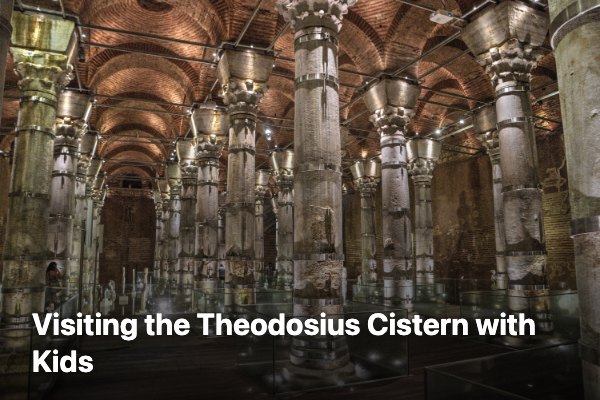
Humidity is near 100 percent. This is the venue’s own figure, and it is the reason the projection equipment sits in purpose built cabinets. In practice it means water drips from the ceiling in places and every surface is faintly damp.The floor is damp and can be slippery. Both the venue’s visitor guidance and the education ministry’s site advise against running and recommend care underfoot. Flat shoes with a rubber sole, and no flip flops.It is cool. No official temperature is published, but the chamber is underground with two and a half metre walls and it holds a steady cool whatever the street is doing. In July this is a relief. In February it is a reason to keep coats on.Lighting is dim throughout and dimmer during the show. The lights do not come fully up afterwards either, so the whole visit is low light.The acoustics are live. Eleven metre vaults over stone produce real reverberation, which is why the cistern hosts concerts. Children’s voices carry a long way, which is worth mentioning to them at the door.The railings are low. This is the one genuine safety point. The venue prohibits leaning on them, and with small children the sensible approach is to keep them on the inside of the walkway.Is the projection show suitable for young children?
No official age guidance exists, so here is what can be said factually and what has to be judged by you.The show runs nine minutes and forty seconds and uses 3D animation projected across all the walls, columns and vaults from 29 projectors. It is structured in five sections covering Istanbul’s waterways, the Byzantine period, the Ottoman period and the Republic. Nothing about it is designed to startle, and no source describes it as loud or as containing sudden blackouts.What you are judging is whether your particular child is comfortable in a dark underground chamber with moving imagery on every surface and amplified sound in a reverberant space. Children who like planetariums generally like this. Children who find dark enclosed spaces difficult will find this difficult, and the fact that it is underground is not something you can mitigate once you are down there.The running time is on your side. Under ten minutes is short enough that even a child who is uneasy can usually sit through it.Turkish state broadcasting’s parenting platform lists the cistern as a weekend outing with children, which is at least a mainstream signal that it is treated locally as child appropriate.What children actually find interesting here
The history is abstract for young children. The physical facts are not, and these are the ones worth pointing out.It is a giant underground water tank. That framing lands better than “Byzantine cistern”. It held water for the palace baths, and the whole room used to be full.The floor is 1,600 years old. Unlike most Byzantine substructures in the city, this one kept its original paving, so they are standing on the actual floor.There are 32 columns and 45 vaults. Counting them is a genuinely effective way to occupy a seven year old for ten minutes.The walls are two and a half metres thick with curved corners, built that way to hold back the pressure of the water.There is a building on top of it. The cistern sat underneath a mansion and then a municipal office block, and nobody could visit it until the buildings above were demolished in 2010.The show is projected, not printed. Older children usually want to know how the images bend around the columns, and the answer, that the video is distorted in advance to fit the shape of the room, is a satisfying one.More background for the older ones is on the history page.Timing a family visit
The show runs on the hour, and this is the single most useful piece of planning information for a family.Arrive at ten minutes to the hour. You buy or scan the ticket, go down, and the show begins shortly after. Arrive at twenty past and you are managing children through a wait of up to forty minutes with nothing to look at except a chamber you have already seen.| Time of day | Suits families because |
|---|---|
| At opening | Quietest hour, empty chamber, easiest with a pushchair |
| Late morning | Busiest, avoid if you can |
| Early afternoon | Steady, works well after lunch in Sultanahmet |
| Late afternoon | Quiet again, and a good indoor stop if the weather has turned |
Facilities, and what to sort out beforehand
Toilets. Sources conflict on whether these are available to visitors. The entrance building was designed with toilets on the upper floor, but visitor reports say there are none accessible inside. Use the facilities before you arrive rather than counting on them.Baby changing. No information exists either way. Assume there is none.Lockers. None, stated explicitly on the official visitor rules. Suitcases and large travel bags are refused at the door.Food and drink. Not permitted inside the chamber. There is a cafe at the exit level.Somewhere to sit. The archaeological park immediately outside has two public squares with a reflecting pool between them and mature trees on the south and west sides. It is free, open and the natural place to regroup with children before or after.Pets. Permitted if kept in a carrier, according to the official visitor rules.Where to go next with children
The cistern’s position is its practical strength for a family day, since everything nearby is public, open air and free.One to two minutes. The Column of Constantine on Divan Yolu, and the Cemberlitas tram stop.Five minutes. Sultanahmet Square and the Hippodrome, which is flat, pedestrianised and wide enough to let children walk without being held. The Obelisk of Theodosius, the Serpent Column and the German Fountain are all there.Ten minutes. Hagia Sophia and the Blue Mosque, both reached across Sultanahmet Square.Around fifteen minutes. Gulhane Park, which is the closest proper green space with room to run.Pairing the cistern with the Hippodrome works particularly well, because forty minutes underground followed by an open square is the right order for most children and the whole combination costs one ticket.School groups
The cistern is a registered out of school learning environment with the Turkish Ministry of Education, with defined learning outcomes mapped from pre school through Year 8 across history, social studies, science, mathematics and visual arts. The light units in the science curriculum tie directly to the projection installation.The published rules for groups are to keep the group together, stay on the marked route, avoid running, not touch the columns, keep noise down and not interfere with the light and sound equipment. The student discount applies on production of documentation.No official statement requires school groups to book in advance, but given the hourly show cycle and the size of the chamber, contacting the venue ahead is the sensible approach.Frequently asked questions
Is the Theodosius Cistern free for children?
Children aged six and under enter free when accompanied by family. This is published on the venue’s Turkish visitor page though not on the English one. Students of any age qualify for the reduced rate on production of a student card.Is the cistern suitable for toddlers?
For most, yes. It is short, enclosed and safe provided you keep hold of them on the stairs and away from the low railings. The floor is damp so flat grippy shoes matter. Children who dislike dark enclosed spaces will find the setting difficult, and that is the thing to judge in advance.Can you take a pushchair into the Theodosius Cistern?
There is a lift at the entrance and the internal route is level, though the venue does not publish this and there are no lockers if you need to leave anything. A compact fold or a baby carrier is the safer plan. Call ahead on 0212 222 28 82 if step free access is essential.Is the light show scary for children?
Nothing in the show is designed to startle and no source describes it as loud or as containing sudden darkness. It runs under ten minutes with animated imagery across the walls and vaults. Children who enjoy planetariums typically enjoy it. The chamber is dim throughout, before and after.How long should a family allow?
Thirty to forty five minutes inside, plus arrival ten minutes before the hour so you catch the show without waiting. Adding a stop in the squares outside makes an hour in total.Are there toilets at the cistern?
Sources disagree, with the building’s design including toilets on the entrance level but visitor reports saying none are available inside the chamber. Treat facilities as unavailable and go beforehand.Can children take photographs?
Yes, during the daytime visit. Flash is useless at this distance in a dark chamber and should be switched off. Tripods and professional equipment need written permission. Photography is not permitted during the evening ceremony.Is it better than the larger cistern for families?
For a family, often yes. It is a tenth of the size with a tenth of the columns, which means less walking and less crowd, there is rarely a queue, and the projection show holds children’s attention in a way that a static ruin does not. The two are compared in the comparison guide.Is the Theodosius Cistern suitable for children?
Yes, it is a popular stop for families, and children often enjoy the colourful lighting and the underground atmosphere.
Questions answered in this guide
- Is the projection show suitable for young children?
- Is the Theodosius Cistern free for children?
- Is the cistern suitable for toddlers?
- Can you take a pushchair into the Theodosius Cistern?
- Is the light show scary for children?
- How long should a family allow?
- Are there toilets at the cistern?
- Can children take photographs?
- Is it better than the larger cistern for families?
- Is the Theodosius Cistern suitable for children?
- Can I bring a stroller into the cistern?
- How long will children enjoy the visit?
- Is the cistern safe for children?
- Is there anything special for kids?
Can I bring a stroller into the cistern?
Access to the underground space is via stairs, which can be difficult with a stroller, so you may prefer a baby carrier.
How long will children enjoy the visit?
Most families spend around 30 to 45 minutes, which is usually a comfortable length for children.
Is the cistern safe for children?
Yes, but please keep children close on the walkways, as some areas are dim and the surfaces can be uneven.
Is there anything special for kids?
The light and projection show is a highlight that many children find captivating.
Planning your trip to Istanbul? Read our Theodosius Cistern visit guide for directions and practical tips, or book your tickets for a daytime visit or the evening whirling dervish ceremony.
Planning a visit? Ask AI to summarise this page
Open this article in your preferred assistant to get the key facts for your trip.
Ask ChatGPTAsk ClaudeAsk Perplexity
Comment (0)