
Last reviewed and updated: October 2, 2026
The hour matters more than the month here. The chamber is fifteen metres underground behind two and a half metre walls, so it holds the same cool, dim, humid conditions in January as in August, and the projection mapping show runs on the hour regardless of the weather outside. What changes across the year is how many other people are in Sultanahmet, and what changes across the day is whether you walk straight in or wait forty minutes at the door.Below is the month by month picture, then the hour by hour one, which is the more useful of the two.Month by month
| Month | Street conditions | Crowds at the cistern | Verdict |
|---|---|---|---|
| January | 9.6 °C, 16 rainy days | Lightest of the year | Best for an empty chamber |
| February | 10.2 °C, snow possible | Light | Good, and a warm indoor stop |
| March | 12.4 °C, 13 rainy days | Building | Good |
| April | 17.4 °C, tulips in the parks | Busy | Pleasant, book ahead |
| May | 22.3 °C, dry | Busy | One of the best months in the city |
| June | 27.1 °C, thunderstorm peak | Heavy | Go early or late |
| July | 29.7 °C, driest month | Heaviest | The cool underground is the point |
| August | 29.7 °C, humid | Heaviest | Same, arrive at opening |
| September | 25.9 °C, second storm peak | Heavy easing to busy | Very good |
| October | 20.6 °C, rain returns | Easing | Very good |
| November | 16.1 °C, dark by 17:47 | Light | Good |
| December | 11.8 °C, wettest month | Light | Best value, plan around the rain |
Time of day, which matters more
The projection mapping show runs on the hour and lasts nine minutes and forty seconds. Visitors are admitted in hourly batches around it. That single fact decides how your visit goes.Arrive at ten minutes to the hour. You buy or scan the ticket, go down, and the show begins shortly after.Arrive at twenty past and you may be waiting up to forty minutes at the door, with nowhere inside to sit.| Hour | What to expect |
|---|---|
| At opening | The quietest hour of the day and the best for photographs without people in frame |
| Late morning | The busiest window, with groups arriving from Sultanahmet Square |
| Early afternoon | Steady, and rarely any queue at the ticket desk |
| After 19:00 | Quiet again, and a good stop once the peninsula’s big sites have closed |
Weekdays against weekends
Weekdays, comfortably. Saturday and Sunday bring both visitors and residents into Sultanahmet, and the cistern picks up overflow from the busier sites nearby.Two dates to know about. Every child in the world enters the operator’s museums free on 23 April, National Sovereignty and Children’s Day, and free entry campaigns also run during the winter half term in late January and early February, on Museums Day in May and on 19 May. Those days are excellent value and correspondingly busy.How crowded does it actually get?
Less than you would expect for a site five minutes from Sultanahmet Square.The venue’s own homepage cites around 500 daily visitors, which is modest for that location. Annual figures reported by the operator show 84,157 visitors in 2021 and 223,766 in the first ten months of 2022, so the trend is upward but the base is small.The practical effect is that there is usually no queue at the ticket desk at any hour. What creates a wait is the hourly show cycle, not congestion. This is the opposite of the situation at the larger cistern nine minutes away, where the queue is at the entrance and the interior is crowded once you are through it.The comparison is set out in the guide to both cisterns.When to come for photographs
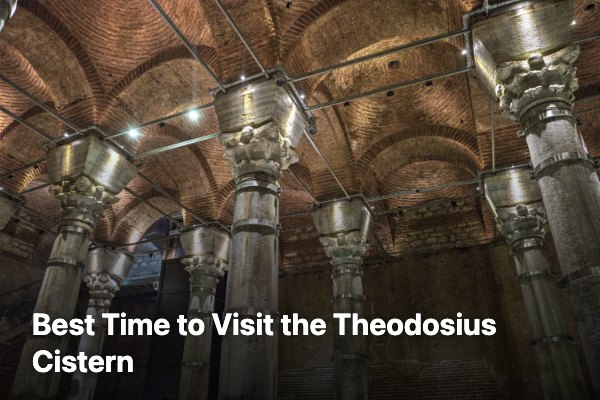
The projection show is the light source, so the time of day outside is irrelevant. What matters is how many people are in the chamber.Come at opening. An empty 24 by 40 metre hall with the mapping running across 32 columns is the shot, and it is only available in the first hour or the last.Stand toward the middle of the walkway. The mapping is designed to be read from the centre, and a wall position puts you inside the projection rather than in front of it.Switch flash off. It is useless at this distance in a dark chamber and it ruins the show for everyone else.Expect low light throughout. The lights do not come fully up after the show ends, so the whole visit is dim.Keep the lens covered between shots. Humidity runs near 100 percent and water drips from the ceiling in places.Tripods and professional equipment need written permission.The evening programme, which is a different visit
There is a separate evening ticket, and it is not simply a later version of the daytime one.Doors open at 19:45, the programme runs from 20:00 with an introduction, the projection show at 20:15 and a live sema ceremony with Sufi musicians from 20:30, finishing around 21:15.So the commitment is an hour and a half rather than forty five minutes, it is seated and timed rather than a walk in, and it needs booking ahead. Photography is not permitted during the ceremony, and the venue is not wheelchair accessible for that programme.Which to choose comes down to what you want from the room. The daytime visit is about the architecture and the mapping. The evening programme is about the acoustics, which a chamber with eleven metre vaults and two and a half metre walls does exceptionally well.Fitting it into a Sultanahmet day
The cistern’s strongest practical argument is that it costs so little time. Thirty to forty five minutes inside, five to ten minutes’ walk from the T1 tram at Cemberlitas or Sultanahmet, and rarely a queue.That makes it a filler rather than a fixture, and there are two natural slots.Late morning, between the mosques and lunch. The monuments in Sultanahmet Square are at their most crowded then, and stepping underground for forty five minutes is a sensible way to sit that hour out.Late afternoon, after the big sites close. Most of the peninsula’s ticketed attractions shut earlier than the cistern does, and this is a useful last stop before dinner.Within a ten minute walk you have the Column of Constantine at Cemberlitas, Sultanahmet Square and the Hippodrome with its three monuments, the larger cistern, and Hagia Sophia and the Blue Mosque beyond. None of that needs booking around the cistern, which is the point.Tickets and payment
| Category | Price |
|---|---|
| Foreign visitor | 900 TL |
| Full, Turkish residents | 330 TL |
| Reduced, students, teachers, police, military | 90 TL |
| Children 6 and under with family | Free |
What the season does not change
Worth stating, because it is the reason this site behaves differently from everything else on the peninsula.The chamber is underground with walls around two and a half metres thick, coated in waterproof plaster, with curved corners built to hold back the pressure of stored water. It runs cool and at near 100 percent humidity all year. The floor is damp in every month. The lighting is artificial in every month.Rain does not affect it. Snow does not affect it. Heat does not reach it. The only weather that matters is what it does to the queue at the site you visit before or after.The building and how it was made are covered on the history page.Frequently asked questions
What is the best time of day to visit the Theodosius Cistern?
At opening or after 19:00, and in both cases arriving ten minutes before the hour so you catch the projection show without waiting. Late morning is the busiest window, since it takes overflow from the monuments on Sultanahmet Square.What is the best month to visit?
The chamber is underground and unaffected by season, so the answer is really about the city outside. April, May, September and October are the best months in Istanbul generally. December and January are the quietest here. July and August are the busiest, though the cool underground temperature is at its most welcome then.How long does the visit take?
Between 30 and 45 minutes, including the nine minute and forty second projection show. It is a single hall of about 960 square metres with 32 columns, so there is no route to complete and no collection to work through.Is there a queue at the Theodosius Cistern?
Rarely at the ticket desk. What creates a wait is the hourly show cycle, so arriving mid cycle can mean up to forty minutes at the door. The site records around 500 visitors a day, which is modest for its location.Is it worth visiting in winter?
Yes, and it is one of the better winter options in Sultanahmet. It is indoor, takes under an hour and is unaffected by rain, which matters in December when Istanbul averages around 99 mm across fifteen or sixteen wet days. Bring a layer, since the chamber is cool year round.What time does the light show run?
On the hour, lasting nine minutes and forty seconds. Arriving ten minutes before the hour is the way to avoid waiting.What time does the Theodosius Cistern close?
The venue’s own site gives 22:00 in its main text and 18:00 in its footer, which is an unresolved contradiction on its own pages. If you are planning a late visit, confirm by phone on 0212 222 28 82.Should you book ahead?
Not usually necessary for the daytime visit, since queues at the desk are rare. Booking removes the desk step, which helps if you are timing your arrival to a specific show. The evening ceremony does need advance booking, as it is a seated, capacity limited event.When is the best time to visit the Theodosius Cistern?
Early in the day or on weekdays is usually the quietest time, letting you enjoy the cistern and its lighting without the crowds.
Questions answered in this guide
- How crowded does it actually get?
- What is the best time of day to visit the Theodosius Cistern?
- What is the best month to visit?
- How long does the visit take?
- Is there a queue at the Theodosius Cistern?
- Is it worth visiting in winter?
- What time does the light show run?
- What time does the Theodosius Cistern close?
- Should you book ahead?
- When is the best time to visit the Theodosius Cistern?
- Is the Theodosius Cistern busy?
- What is the quietest season to visit?
- Is the cistern open all year round?
- How long should I spend at the Theodosius Cistern?
Is the Theodosius Cistern busy?
It is generally far less crowded than the Basilica Cistern, though weekends and the high summer season can be busier.
What is the quietest season to visit?
Spring, autumn and the winter months tend to be calmer than the peak summer period.
Is the cistern open all year round?
Yes, the cistern welcomes visitors throughout the year; please check your ticket for the current times.
How long should I spend at the Theodosius Cistern?
Most visitors spend around 30 to 45 minutes exploring the space and watching the light presentation.
Planning your trip to Istanbul? Read our Theodosius Cistern visit guide for directions and practical tips, or book your tickets for a daytime visit or the evening whirling dervish ceremony.
Planning a visit? Ask AI to summarise this page
Open this article in your preferred assistant to get the key facts for your trip.
Ask ChatGPTAsk ClaudeAsk Perplexity
Comment (0)