
Last reviewed and updated: November 14, 2026
Sultanahmet packs Istanbul’s biggest historic sights into a walkable square roughly the size of a large park.
Questions answered in this guide
- What is the easiest way to see Sultanahmet on foot?
- Why visit the Theodosius Cistern in Sultanahmet?
- How does the Theodosius Cistern compare to the Basilica Cistern?
- Is the evening dervish show worth adding to a Sultanahmet day?
- What else sits within the 10-minute radius?
- How much time should a visitor plan for Sultanahmet?
- Is Sultanahmet walkable without public transport?
- What is the Theodosius Cistern’s daytime visiting window?
- Can luggage be brought into the Theodosius Cistern?
- Is the Theodosius Cistern the same as the Basilica Cistern?
- How long does the evening dervish show last?
- Do Hagia Sophia and the Blue Mosque require separate tickets?
Hagia Sophia, the Blue Mosque, Topkapı Palace, the Hippodrome and the Theodosius Cistern all sit within a 10-minute walk of each other, so a visitor can cover the core of old Istanbul on foot in a single day without taking a taxi or tram.
- Area: Sultanahmet, the historic peninsula of Istanbul’s Old City
- Walking radius: every major sight below sits within about 10 minutes on foot of Sultanahmet Square
- Best for: first-time visitors with one or two days and no car
- Nearest tram stop: Sultanahmet, on the T1 line
What is the easiest way to see Sultanahmet on foot?
Start at Sultanahmet Square and work outward in a loop, since every landmark in this guide sits on or just off the square itself.
The square is flanked by Hagia Sophia on one side and the Blue Mosque on the other, with the Hippodrome running between them. From there, side streets lead downhill toward the Basilica Cistern and the Theodosius Cistern, and uphill toward Topkapı Palace and the Archaeology Museums.
None of these connections require a vehicle.
A comfortable pace covers the whole loop in half a day, with time to go inside two or three sites.
Hagia Sophia: what to expect at the centre of Sultanahmet
Hagia Sophia is the domed former cathedral and mosque that anchors the whole district, and most visitors treat it as the natural starting point for a Sultanahmet walk.
Built in the 6th century and converted between church, mosque and museum uses over the centuries, it now functions as an active mosque. Entry rules, dress codes and visiting hours are set by Türkiye’s cultural authorities rather than by any private operator, so it is worth checking the current arrangements directly before arriving.
The official Turkish museums and monuments portal publishes the up to date visiting rules.
The Blue Mosque and the Hippodrome
The Blue Mosque sits directly across the square from Hagia Sophia, a two to three minute walk, with the old Hippodrome running along its western edge.
The Hippodrome was the chariot racing ground of Byzantine Constantinople and is now an open public square lined with obelisks and monuments, including the Egyptian Obelisk and the Serpent Column. Walking the length of it takes a few minutes and gives a sense of scale for a structure that once held tens of thousands of spectators.
The Blue Mosque itself, formally the Sultan Ahmed Mosque, is recognisable by its six minarets and the blue İznik tiles inside.
Topkapı Palace and the Archaeology Museums
Topkapı Palace sits a short uphill walk from Hagia Sophia and was the administrative seat of the Ottoman sultans for roughly four centuries.
The palace complex includes several courtyards, the Harem section, and views over the Bosphorus strait from its outer terraces. Just below the palace walls, the Istanbul Archaeology Museums hold finds from across the former Ottoman territories, including sarcophagi and classical sculpture.
Both sites reward a slower pace than a quick walk-through, so visitors with only an afternoon in Sultanahmet often have to choose between the palace and a deeper look at the cisterns below the streets.
Why visit the Theodosius Cistern in Sultanahmet?
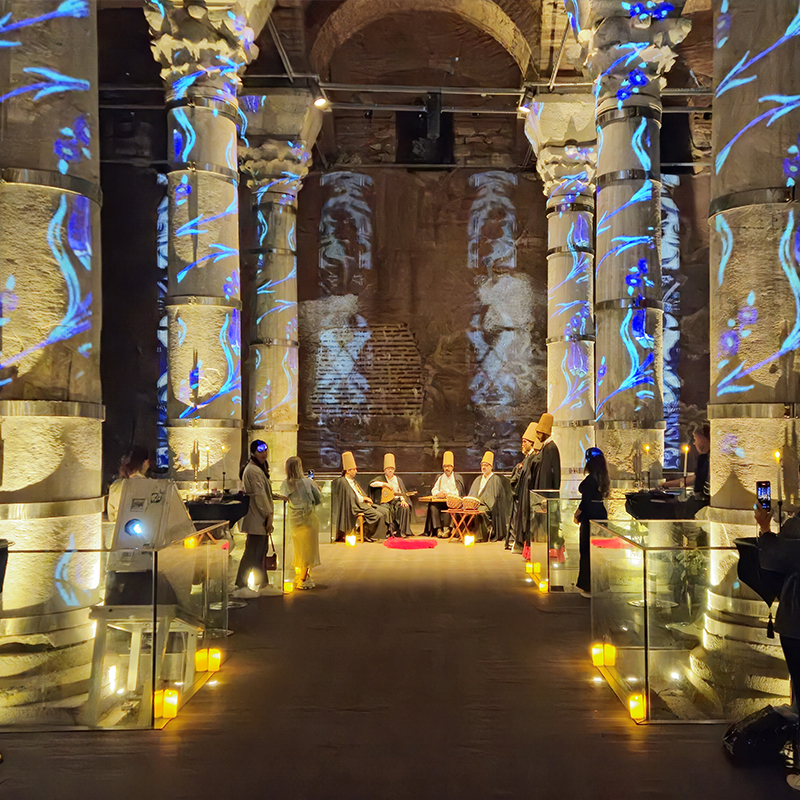
The Theodosius Cistern, known locally as Şerefiye Sarnıcı, is a 5th century underground water reservoir a few minutes’ walk from Sultanahmet Square, and it is one of the few major sights in the district that stays comfortable to visit regardless of weather.
Unlike the open-air monuments above ground, the cistern sits below street level in a vaulted stone chamber supported by rows of columns. A daytime visit runs within the site’s published session hours of 9:00 am to 6:00 pm, and includes access for the chosen session along with a mapping light show projected across the stone surfaces.
In the evening, a separate dervish show ticket runs from a 7:45 pm entrance through to roughly 9:15 pm, combining the mapping show with a whirling dervish performance and live Sufi music, plus snacks and drinks.
Because the cistern sits underground, visitors should note that luggage is not allowed inside, and professional photography requires written permission in advance. Tickets for either session can be arranged directly; visitors can book Theodosius Cistern tickets ahead of a Sultanahmet walking day to lock in a session time.
For a wider view of what else is nearby, the site’s own guide to things to do near the Theodosius Cistern covers the surrounding streets in more detail.
How does the Theodosius Cistern compare to the Basilica Cistern?
Both are Byzantine era underground reservoirs a few minutes apart, but they differ in scale and atmosphere, and most first-time visitors benefit from understanding the difference before choosing one.
The Basilica Cistern, the larger and better known of the two, draws heavier crowds and is often included on general Istanbul itineraries. The Theodosius Cistern is smaller, quieter, and built around its own programme of light and sound shows rather than being purely a walk-through site.
A full comparison of Istanbul’s underground cisterns, including how each one was built and what survives today, is covered in the site’s own guide to Istanbul’s ancient cisterns.
Is the evening dervish show worth adding to a Sultanahmet day?
Yes, for visitors who want to end a day of walking with something seated and atmospheric rather than another open-air monument.
A sema, or whirling dervish ceremony, is a form of Sufi devotional dance historically performed to live music, and the version staged inside the Theodosius Cistern pairs it with the same 360° projection mapping used in the daytime show.
The sequence runs from a 7:45 pm entrance, through the mapping show at 8:15 pm, to the dervish performance itself at 8:30 pm, finishing by 9:15 pm. A dedicated walkthrough of the format, including what the performance covers and how the evening is structured, is in the site’s guide to the whirling dervish show.
What else sits within the 10-minute radius?
Several smaller sights fill the gaps between the headline monuments, and most visitors stumble onto them simply by walking between the bigger stops.
- The German Fountain, a small domed pavilion at the north end of the Hippodrome, gifted to Istanbul in the early 20th century.
- The Million Stone, a fragmentary Byzantine milestone marking the point from which distances across the empire were once measured.
- Sultanahmet Square’s own tram stop on the T1 line, useful for continuing on to the Grand Bazaar or across the Galata Bridge.
- Side street cafes and carpet shops along Divan Yolu, the old Byzantine and Ottoman ceremonial road running through the district.
None of these require a separate trip; they sit along the natural paths between Hagia Sophia, the Blue Mosque, and the cisterns.
How much time should a visitor plan for Sultanahmet?
A full day gives enough time to see the major monuments properly and still fit in one underground cistern visit without rushing between sites.
A shorter half-day works for visitors who only want the open-air sights: Hagia Sophia, the Blue Mosque and the Hippodrome. Visitors adding Topkapı Palace or a full museum visit should plan extra time, since the palace alone can take a couple of hours to walk through properly.
Public transport information for reaching Sultanahmet from other parts of the city, including tram and ferry connections, is published on Türkiye’s official tourism portal.
Frequently Asked Questions
Is Sultanahmet walkable without public transport?
Yes. Every major sight covered in this guide, from Hagia Sophia to the Theodosius Cistern, sits within about a 10-minute walk of Sultanahmet Square, so a full day of sightseeing can be done entirely on foot.
What is the Theodosius Cistern’s daytime visiting window?
9:00 am to 6:00 pm. That is the published session window for the daytime visit, which includes access for the chosen session and the on-site mapping light show.
Can luggage be brought into the Theodosius Cistern?
No. Luggage is not permitted inside the cistern, so visitors arriving straight from a hotel checkout or airport transfer should plan to leave bags elsewhere first.
Is the Theodosius Cistern the same as the Basilica Cistern?
No. They are two separate Byzantine era underground reservoirs a few minutes apart in Sultanahmet, with the Basilica Cistern being the larger and more visited of the two.
How long does the evening dervish show last?
About 1.5 hours. Entrance begins at 7:45 pm, the mapping show runs from 8:15 pm and the dervish performance from 8:30 pm, with the full programme finishing around 9:15 pm.
Do Hagia Sophia and the Blue Mosque require separate tickets?
Separately managed. Both sites set their own entry and dress rules through Türkiye’s cultural authorities, so it is worth checking current requirements before visiting either one.
Sultanahmet rewards a slow, looping walk more than a fixed checklist. Starting at the square, moving between Hagia Sophia, the Blue Mosque and the Hippodrome, then dropping underground into the Theodosius Cistern, covers the district’s full range in a single comfortable day, on foot, in Istanbul as it stands in November 2026.
Planning a visit? Ask AI to summarise this page
Open this article in your preferred assistant to get the key facts for your trip.
Ask ChatGPTAsk ClaudeAsk Perplexity
Comment (0)