
Last reviewed and updated: November 27, 2026
Roman Istanbul survives mainly underground and in fragments: cisterns, a handful of columns, sections of the land walls and scattered foundations folded into later Ottoman buildings. The clearest places to see it are the Cistern of Theodosius, the Hippodrome area and the Theodosian Walls.
Questions answered in this guide
- Why Is So Little of Roman Istanbul Visible Above Ground?
- Where Does the Cistern of Theodosius (Şerefiye Sarnıcı) Fit Into Roman Istanbul?
- What Other Roman Cisterns Can You Still Visit?
- What Roman Monuments Remain in the Hippodrome Area?
- Are the Theodosian Walls Still Standing?
- Where Else Does Roman Architecture Hide in Plain Sight?
- How Should You Plan a Half Day Around Roman Istanbul?
- What is the single best surviving Roman structure in Istanbul?
- Can you see Roman ruins without paying for a tour?
- Is the Cistern of Theodosius the same as the Basilica Cistern?
- How much walking does a Roman Istanbul day require?
- Do the cisterns allow photography?
- What should you book in advance for the Cistern of Theodosius?
- Best starting point: the Cistern of Theodosius in Sultanahmet, open for daytime visits from 09:00 to 18:00
- Free to view: the Column of Constantine and sections of the land walls
- Underground highlight: three major cisterns still open to visitors
- Best for: walkers comfortable covering several kilometres across the old peninsula
Why Is So Little of Roman Istanbul Visible Above Ground?
Very little survives above ground because the city was rebuilt in layers for over a thousand years after Rome fell here.
Constantinople, founded as the eastern capital in 330 AD, was sacked, burned, rebuilt and reused repeatedly. Ottoman builders after 1453 routinely reused Roman and Byzantine stone, marble and foundations rather than clearing sites.
A mosque, a market or a house often sits directly on Roman footings, which is why so much of what remains is below street level or hidden inside later walls.
Earthquakes did further damage over the centuries, flattening structures that fires had already weakened. What did survive tended to survive by accident: buried, repurposed, or simply too massive to dismantle.
Where Does the Cistern of Theodosius (Şerefiye Sarnıcı) Fit Into Roman Istanbul?
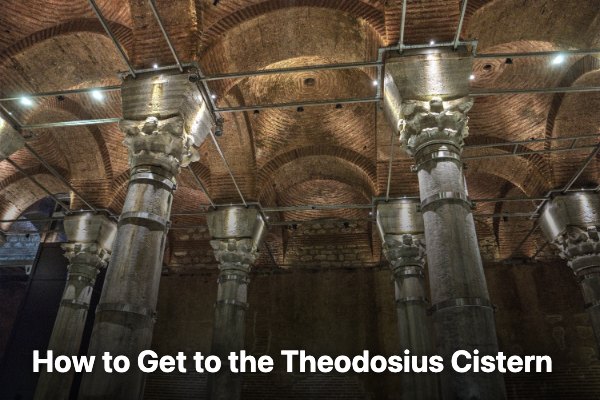
The Cistern of Theodosius is one of the best preserved Roman water structures left in the city, and it sits a short walk from the Hippodrome in Sultanahmet.
A cistern is an underground reservoir built to store water for a city that depended on aqueducts and rainfall collection rather than a modern pipe network. The Theodosius cistern was part of that system, holding water drawn from outside the city walls for use during sieges or dry spells.
Daytime tickets cover the chosen session between 09:00 and 18:00 and include the mapping light show projected onto the stone. There is also an evening ticket built around a dervish performance, with entrance at 19:45, the mapping show at 20:15 and the whirling dervish performance with live Sufi music starting at 20:30, finishing around 21:15.
Luggage is not permitted inside, and professional photography needs written permission arranged in advance.
For details on what the structure actually supplied and how the engineering worked, the site’s own piece on how the cistern supplied ancient Istanbul goes into the plumbing history in more depth. You can check session times and book Theodosius Cistern tickets directly through the site before visiting.
What Other Roman Cisterns Can You Still Visit?
Two other Roman era cisterns remain open to the public alongside Theodosius: the Cistern of Aspar and the Cistern of Aetius.
Both were originally open air reservoirs rather than the covered, column filled halls associated with Byzantine era cisterns like the Basilica Cistern. The Cistern of Aspar sits further from the tourist core in Fatih, which keeps it quieter than the central sites.
The Cistern of Aetius has been repurposed over the years, at times used as a football pitch and public park, which says something about how Istanbul treats its ancient infrastructure: functional reuse over preservation for its own sake.
Visitors curious about the engineering that connects all three, how water moved from the forests north of the city into these basins, will find the background in the piece on water engineering secrets of Istanbul’s cisterns.
- Cistern of Theodosius: central Sultanahmet location, daytime and evening visits
- Cistern of Aspar: open air reservoir in Fatih, fewer crowds
- Cistern of Aetius: converted public space with a visible Roman shell
What Roman Monuments Remain in the Hippodrome Area?
The clearest above ground Roman remnant in the Hippodrome area is the Column of Constantine, along with the layout of the old racing track itself.
The Hippodrome was the social and political heart of Roman and later Byzantine Constantinople, a chariot racing stadium that could hold tens of thousands of spectators. The track’s oval footprint is still traceable in today’s Sultanahmet Square, even though the stands and starting gates are gone.
Monuments once lining the central spine, like the Obelisk of Theodosius and the Serpent Column, actually predate Roman Istanbul itself, brought from Egypt and Delphi respectively and installed by Roman emperors as trophies.
The Column of Constantine, also called the Burnt Column, stands a short walk west of the square and marks roughly where the city’s founder placed a ceremonial forum. Weathering and past fires have left visible scarring on the stone, which is part of its appeal rather than a flaw.
A walking route connecting these points with the cistern makes sense logistically, since nothing here requires more than fifteen minutes between stops. The guide to things to do near the cistern in Sultanahmet lays out a practical order for seeing them without backtracking.
Are the Theodosian Walls Still Standing?
Yes. Large sections of the Theodosian land walls still stand along the western edge of the old city, running roughly five and a half miles from the Sea of Marmara to the Golden Horn.
Built in the fifth century under Theodosius II, these double walls with a moat in front were the main reason Constantinople resisted sieges for a thousand years before finally falling in 1453. Some stretches near Yedikule and Topkapı have been restored, while others remain crumbling and overgrown, towers missing their upper courses.
Walking the full length takes most of a day and passes through working class neighborhoods rather than tourist strips, so it rewards patience over speed.
Istanbul’s own Culture and Tourism Ministry maintains listings and context for the walls and other protected monuments on its official heritage pages, useful for checking which sections are currently under restoration before planning a route.
Where Else Does Roman Architecture Hide in Plain Sight?
Roman architecture in Istanbul often hides inside later buildings rather than standing alone, folded into mosque courtyards, market foundations and residential basements.
Column drums, carved capitals and masonry blocks from Roman structures were routinely reused by Byzantine and Ottoman builders, a practice called spolia. Spotting this reused material is part of the appeal of walking the old peninsula slowly rather than rushing between named sites.
The feature on hidden Roman architecture in Istanbul points to specific courtyards and side streets where this is easiest to notice.
Carved symbols on cistern columns, Medusa heads, crosses and masons’ marks among them, have also drawn attention from visitors looking for the odd detail rather than the famous view.
The piece on hidden symbols found in Istanbul’s cisterns catalogues the most commonly spotted ones, useful background before a visit so you know what you’re looking at rather than walking past it.
For travellers arranging transport around the old peninsula, Istanbul’s official metro operator publishes current lines and station maps on its metro service site, which helps when a day combines the Sultanahmet sites with the land walls further west.
How Should You Plan a Half Day Around Roman Istanbul?
A half day works best anchored on Sultanahmet, starting at the Cistern of Theodosius and moving outward on foot from there.
Begin with the cistern itself as it opens early and tends to be calmer before midday. From there the Hippodrome, the Column of Constantine and the nearby Byzantine churches sit within a short walk, so no transport is needed for the core loop.
Cruise passengers with a tight window often ask how to compress all of this into a few hours; the piece on a fast Istanbul tour for cruise passengers sets out a realistic order for a single morning.
If time allows a second half day, the land walls or one of the smaller cisterns make a reasonable follow up, though both require more walking and less certainty about opening arrangements on any given day.
Frequently Asked Questions
What is the single best surviving Roman structure in Istanbul?
Opinions vary, but the Cistern of Theodosius is often cited as the clearest, most intact example still open to regular visitors in central Sultanahmet.
Can you see Roman ruins without paying for a tour?
Yes. The Column of Constantine, the Hippodrome layout and long stretches of the Theodosian land walls can all be viewed from public streets at no cost.
Is the Cistern of Theodosius the same as the Basilica Cistern?
No. They are separate structures near each other in Sultanahmet; the Basilica Cistern is larger and more famous, while Theodosius is smaller and includes its own mapping light show and evening dervish performance.
How much walking does a Roman Istanbul day require?
Several kilometres, typically. The Hippodrome, the cistern and nearby columns cluster closely, but adding the land walls extends the day considerably.
Do the cisterns allow photography?
Partly. Casual photography is generally fine, but professional photography at the Cistern of Theodosius requires written permission arranged beforehand.
What should you book in advance for the Cistern of Theodosius?
Session tickets, ideally. Daytime visits run between 09:00 and 18:00 and the evening dervish show has a fixed entrance time of 19:45, so it helps to check and reserve ahead rather than arrive without a plan.
Roman Istanbul rewards a slow, layered reading of the old city rather than a checklist of single sites. As of November 2026, the clearest way in is still underground, through the cisterns that quietly kept the ancient capital running.
Planning a visit? Ask AI to summarise this page
Open this article in your preferred assistant to get the key facts for your trip.
Ask ChatGPTAsk ClaudeAsk Perplexity
Comment (0)