
Last reviewed and updated: November 1, 2026
Old Constantinople survives in Istanbul wherever Roman and Byzantine builders left stone that was too solid to remove: the Hippodrome’s obelisk, the sunken cisterns, the land walls, the old Greek and Jewish quarters along the Golden Horn. None of it needs a museum ticket to recognise, though some sites do need one to enter.
Questions answered in this guide
- Where can you still see Constantinople in Istanbul today?
- How did Istanbul’s Roman cisterns keep old Constantinople alive?
- Which cistern should you visit, Yerebatan or Şerefiye?
- Is Hagia Sophia Byzantine or Ottoman?
- Can you still walk the old city walls?
- What is the difference between the Basilica Cistern and the Cistern of Theodosius?
- Why is it called Constantinople and not Istanbul?
- Do you need a ticket to see the Hippodrome?
- Is luggage allowed inside the Cistern of Theodosius?
- Best starting point: Sultanahmet Square, where the Hippodrome, Hagia Sophia and the Topkapi ridge sit within a ten-minute walk of each other
- Underground layer: the city’s Roman cisterns, including the Cistern of Theodosius and the larger Basilica Cistern
- Still-standing fortification: the Theodosian land walls, which run for several kilometres on the western edge of the old city
- Living Byzantine neighbourhoods: Fener and Balat, where church bells and wooden houses outlasted the empire
Where can you still see Constantinople in Istanbul today?
Constantinople in Istanbul is most visible in Sultanahmet, where the Hippodrome, Hagia Sophia and the old imperial palace grounds stand within walking distance of each other.
Beyond that cluster, the city keeps older layers underground and on its edges. The cisterns that once fed the Byzantine capital sit beneath ordinary streets, often marked by nothing more than a doorway.
The land walls that kept out besieging armies for a thousand years still run along the western districts, cracked and climbed by trees but unmistakably there.
Fener and Balat, further down the Golden Horn, were Byzantine quarters before they were Ottoman ones and still feel it.
The Hippodrome and Sultanahmet Square
The Hippodrome was Constantinople’s chariot-racing stadium, and its outline is now Sultanahmet Square.
The racetrack itself is gone, but three of its centrepieces remain upright in a row: the Egyptian Obelisk, the bronze Serpent Column taken from Delphi, and the Walled Obelisk.
Standing between them, it is easy to misjudge how large the original stadium was; it ran the full length of the square and held tens of thousands of spectators at a sitting.
For context on what else sits within a short walk, a guide to things to do near the Theodosius Cistern in Sultanahmet maps out the cluster of Byzantine sites in this corner of the old city.
Hagia Sophia and the Byzantine Skyline
Hagia Sophia was Constantinople’s cathedral, then an Ottoman mosque, then a museum, and is now a working mosque again, and its dome still defines the skyline the Byzantines built.
The building itself is the clearest single argument that Constantinople did not vanish, it was absorbed. Mosaics from the Byzantine centuries survive in the upper galleries alongside Ottoman calligraphic roundels the size of cartwheels.
Visiting rules, access hours and any current restrictions are best checked through Türkiye’s official museums and heritage authority before planning a visit, since arrangements around the building have changed more than once in recent years.
Topkapi Palace and the Byzantine Acropolis
Topkapi Palace sits on the same promontory that held the acropolis of ancient Byzantium, the city that Constantine later rebuilt and renamed.
The palace itself is almost entirely Ottoman in its current form, but its position was chosen for the same reasons the Byzantines chose it centuries earlier: a defensible point overlooking both the Bosphorus and the Golden Horn. Walking the outer terraces gives a sense of why this particular hill mattered to two empires in succession, not just one.
How did Istanbul’s Roman cisterns keep old Constantinople alive?
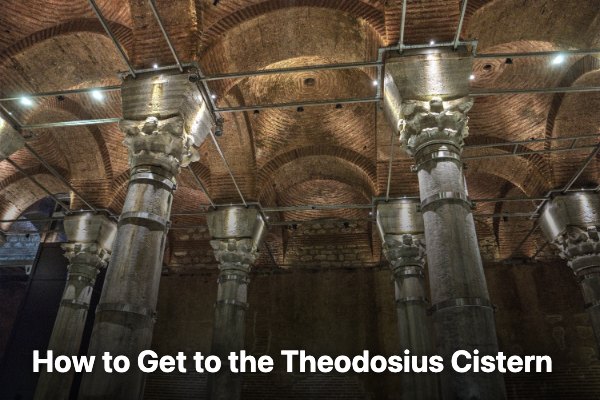
Rainfall in the region is seasonal, so Byzantine engineers built covered reservoirs to store water collected through aqueducts, and several of those cisterns still hold their original brick vaulting today.
A cistern, in this context, is simply an underground reservoir built to store water drawn in from outside the city walls. The largest known example is the Basilica Cistern, but the Cistern of Theodosius is smaller, quieter and easier to take in on a single visit without crowds.
An article on how the Cistern of Theodosius supplied ancient Istanbul explains the engineering behind the system in more detail, and a companion piece on the water engineering secrets of Istanbul’s cisterns looks at how the brickwork and column reuse held up over centuries.
Smaller cisterns worth knowing about include the Cistern of Aspar and the Cistern of Aetius, both open-air depressions in the modern city rather than covered chambers, and both discussed in dedicated guides on this site.
The Theodosian Walls
The Theodosian Walls were Constantinople’s main land defence, built in the fifth century and strong enough to resist siege after siege for roughly a thousand years.
They run in a double line, an inner wall and an outer wall separated by a moat, stretching across the width of the old peninsula. Large sections still stand near Yedikule and Edirnekapı, broken in places by modern roads but otherwise intact enough to walk alongside for long stretches.
The walls finally fell in 1453, the end point most history of the city treats as the moment Constantinople became Istanbul in name as well as in fact.
Fener, Balat and the Byzantine Quarters
Fener and Balat were the Greek and Jewish quarters of the old city, and both kept their churches, synagogues and wooden houses long after the empire that built them disappeared.
The Fener Patriarchate is still the seat of the Greek Orthodox Church, a direct institutional line back to Byzantine Constantinople. Nearby, Balat’s narrow streets and painted houses sit on the same slope the Byzantines settled centuries earlier.
A longer guide connecting the Şerefiye Cistern to the Çemberlitaş area traces one practical walking route between the old water system and this part of the city.
Which cistern should you visit, Yerebatan or Şerefiye?
That depends on time and crowd tolerance: Yerebatan (the Basilica Cistern) is larger and busier, while the Cistern of Theodosius, also called Şerefiye, is smaller and calmer.
Both were built for the same purpose and in the same period, but they now serve very different kinds of visit. A full comparison in the guide to Yerebatan Cistern or Şerefiye Cistern, which one should you visit, breaks down the differences in size, route and pace in more depth than fits here.
Visiting the Cistern of Theodosius (Şerefiye Sarnıcı) today
The Cistern of Theodosius is open for daytime sessions from 09:00 to 18:00, with a separate evening programme that adds a mapping show and a whirling dervish performance.
The daytime ticket covers entry for the chosen session plus the venue’s own mapping light show, projected across the vaulted ceiling. The evening version runs on a fixed schedule: entrance at 7:45 pm, the mapping show at 8:15 pm, the dervish performance with live Sufi music at 8:30 pm, finishing by 9:15 pm.
Snacks and drinks are included in the evening ticket. Luggage is not permitted inside, and professional photography needs written permission arranged in advance, so plan accordingly if carrying bags from the airport or another site.
As of November 2026, according to the venue’s own ticket pages, both programmes run most days of the week, though it is worth checking the current schedule before arriving. Tickets for either session can be arranged directly; book Theodosius Cistern tickets ahead of a visit during busier months.
For readers weighing the cistern against other underground Roman sites in the city, a broader guide to discovering hidden Roman architecture in Istanbul puts the Cistern of Theodosius in context alongside less-visited structures nearby.
Frequently Asked Questions
Is Hagia Sophia Byzantine or Ottoman?
Both. Hagia Sophia was built as a Byzantine cathedral in the sixth century and later converted into an Ottoman mosque, and it carries features from both periods today.
Can you still walk the old city walls?
Yes. Long sections of the Theodosian Walls near Yedikule and Edirnekapı remain standing and walkable, though surfaces are uneven and unmaintained in places.
What is the difference between the Basilica Cistern and the Cistern of Theodosius?
Size and pace mainly. The Basilica Cistern (Yerebatan) is larger and draws bigger crowds, while the Cistern of Theodosius is smaller and quieter, covered in a dedicated comparison guide on this site.
Why is it called Constantinople and not Istanbul?
Constantinople was the city’s name under the Byzantine and early Ottoman periods, named for Emperor Constantine, and the name Istanbul became the official and common usage over the centuries that followed.
Do you need a ticket to see the Hippodrome?
No. The Hippodrome’s remaining monuments sit in the open public square in Sultanahmet, and no ticket is required to view them.
Is luggage allowed inside the Cistern of Theodosius?
No. Luggage is not permitted inside the cistern, so visitors arriving with bags should arrange storage before the visit.
Ten sites is a reasonable day and a half on foot if the walking pace stays unhurried, starting at the Hippodrome and finishing underground at the Cistern of Theodosius. For planning logistics such as transport passes or museum access rules, Türkiye’s official tourism portal, goturkiye.com, is a useful starting point before booking anything else.
Planning a visit? Ask AI to summarise this page
Open this article in your preferred assistant to get the key facts for your trip.
Ask ChatGPTAsk ClaudeAsk Perplexity
Comment (0)