
Last reviewed and updated: October 30, 2026
Theodosius II was the Byzantine emperor who ruled Constantinople from 408 to 450 CE, and his name is attached to two of the city’s most important structures: the land walls that protected it for a thousand years and, by tradition, the cistern now known as the Cistern of Theodosius.
Questions answered in this guide
- Who Was Theodosius II?
- What Are the Theodosian Walls?
- Why Is the Cistern Named After Theodosius?
- How Does the Cistern Fit Into the City’s Water System?
- What Else Is Nearby the Cistern?
- Did Theodosius II personally order the cistern’s construction?
- Are the Theodosian Walls and the Cistern of Theodosius in the same part of Istanbul?
- How long is a visit to the Cistern of Theodosius?
- Can I bring luggage into the cistern?
- Is the Cistern of Theodosius the same as the Basilica Cistern?
- What is shown during the mapping light show?
The wall link is well documented; the cistern’s naming is more a matter of period and location than a direct order from the emperor himself.
- Reign: 408 to 450 CE
- Known for: the Theodosian Walls, the Theodosian law code, and the founding of the University of Constantinople
- Cistern link: built in the same imperial period, in the area the walls were meant to defend
- Where to see the walls today: the land walls run across the western edge of the old city, far from Sultanahmet
Who Was Theodosius II?
Theodosius II became emperor as a child in 408 CE and ruled the Eastern Roman Empire for over four decades, one of the longest reigns of the era. He is remembered less for military conquest than for administration, law and building.
His reign produced the Codex Theodosianus, a compilation of Roman law that shaped legal practice for centuries afterward. He also founded a university in Constantinople and oversaw a period when the city grew fast enough to need new defenses and new infrastructure for water. Both of those needs point toward the two structures that carry his name today.
What Are the Theodosian Walls?
The Theodosian Walls are the double line of land fortifications built under Theodosius II to protect Constantinople from attack on its landward side. They stretch across the peninsula from the Sea of Marmara to the Golden Horn.
The walls consist of an inner wall, an outer wall, and a moat, a layered defense that made the city one of the hardest in the medieval world to besiege directly. They held for roughly a thousand years before finally falling in 1453.
Visitors who want to see them in person need to travel to the western edge of the old city, a separate trip from the cisterns clustered near Sultanahmet.
For practical details on visiting hours and any current restoration work at the walls, Türkiye’s national museums authority is the most reliable official source to check before planning a visit.
Why Is the Cistern Named After Theodosius?
The cistern carries the emperor’s name because it dates from his period and sits in the district associated with his building program, not because a single inscription names him as its builder. Byzantine water infrastructure of this scale was almost always an imperial project.
A cistern, for readers unfamiliar with the term, is an underground reservoir built to store water delivered by aqueduct, protecting the supply from evaporation, contamination and siege. Constantinople needed many of these as its population grew, and the structure now called the Cistern of Theodosius (known locally as Şerefiye Sarnıcı) is one of the surviving examples from that building wave.
The detailed history of how the cistern supplied ancient Istanbul covers the aqueduct network in more depth than fits here.
It is worth being clear that this cistern is a separate site from the better known Basilica Cistern nearby. The piece comparing the Theodosius Cistern against the Basilica Cistern lays out the differences in size, era and atmosphere if a choice between the two is part of the planning.
How Does the Cistern Fit Into the City’s Water System?
The Cistern of Theodosius was one node in a wider network that moved water from forests outside the city, through aqueducts, into storage points like this one before it reached households and public buildings. No single cistern worked alone.
Byzantine engineers built several of these reservoirs across the peninsula, each sized for the district it served.
Two others worth knowing about are the Cistern of Aspar and the Cistern of Aetius, both covered on this site: the guide to the Cistern of Aspar and the piece on the Cistern of Aetius give a sense of how many of these structures the city once relied on.
Seeing more than one in a single trip helps the scale of the ancient system click into place.
Visiting the Cistern of Theodosius (Şerefiye Sarnıcı) Today
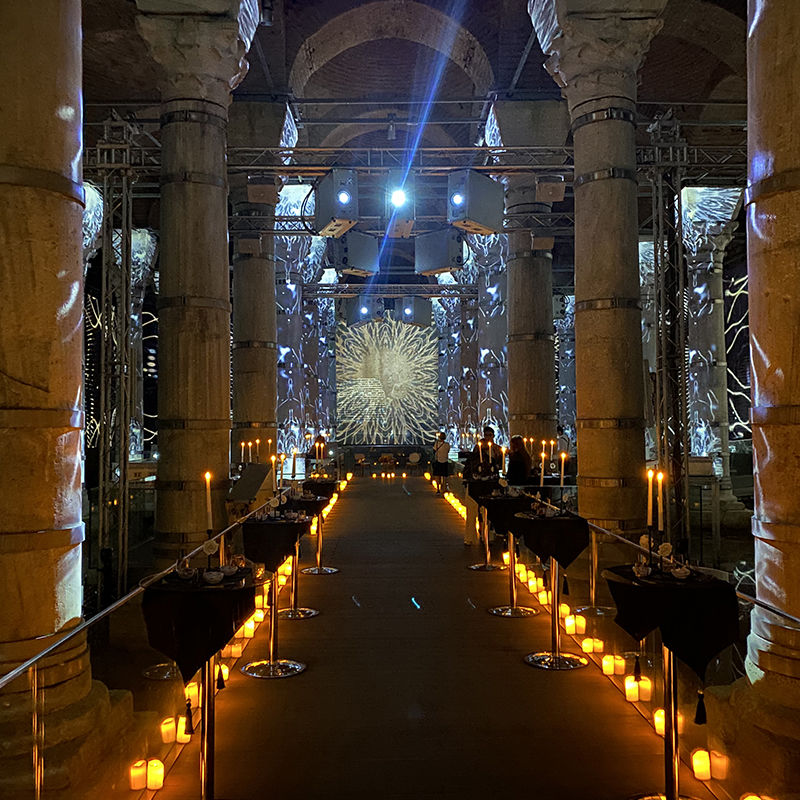
The Cistern of Theodosius operates as a daytime museum site with a mapping light show, open from 9:00 am to 6:00 pm, with a separate evening programme built around a whirling dervish performance. Both formats sit inside the same restored chamber, a short walk from Sultanahmet’s main sights.
The daytime ticket covers entry for the chosen session plus the 360 degree projection mapping shown on the cistern walls, titled either From Past to Present or Istanbul: City of Water Civilization.
The evening option is built differently: entrance is at 7:45 pm, the mapping show runs at 8:15 pm, and the dervish performance with live Sufi music starts at 8:30 pm, with the full programme, including snacks and drinks, finishing by 9:15 pm.
A few site rules matter before arrival. Large luggage is not allowed inside, and professional photography needs written permission arranged in advance. The restoration story behind the site, including how the chamber reopened to visitors, is told in full in the piece on how the Şerefiye Cistern was restored and reopened.
Those ready to pick a session can book Theodosius Cistern tickets directly, choosing between the daytime light show and the evening dervish performance depending on the kind of visit wanted.
What Else Is Nearby the Cistern?
The cistern sits in Sultanahmet, a district dense enough with Byzantine and Ottoman sites that a visit here pairs easily with several others on the same day. Most are within easy walking distance.
The guide to things to do near the Cistern of Theodosius in Sultanahmet lists the closest options without turning the day into a forced march. For travellers deciding between the two main underground sites in the area, the comparison of Yerebatan Cistern against Şerefiye Cistern is a useful next read before booking either.
For general orientation, opening arrangements for museums across the country and any public holiday closures are published by Türkiye’s Ministry of Culture and Tourism, which is worth a quick check if a visit falls near a national holiday.
Frequently Asked Questions
Did Theodosius II personally order the cistern’s construction?
Unclear. The cistern dates from his period and district, which is why it carries his name, but no surviving inscription names him directly as the commissioner of this specific structure.
Are the Theodosian Walls and the Cistern of Theodosius in the same part of Istanbul?
No. The walls run along the western edge of the old city, while the cistern sits in Sultanahmet, a separate area that requires its own trip to reach the walls.
How long is a visit to the Cistern of Theodosius?
About ninety minutes for the evening programme, which runs from 7:45 pm entry to a 9:15 pm finish, according to the venue’s own published schedule. The daytime session fits inside the general 9:00 am to 6:00 pm opening window.
Can I bring luggage into the cistern?
No. Large luggage is not permitted inside the site, so travellers arriving straight from a hotel checkout or the airport should plan to leave bags elsewhere first.
Is the Cistern of Theodosius the same as the Basilica Cistern?
No. They are two different Byzantine reservoirs in the same general area, and the comparison of the Theodosius Cistern against the Basilica Cistern covers the differences in size and atmosphere in detail.
What is shown during the mapping light show?
Two programmes rotate, titled From Past to Present and Istanbul: City of Water Civilization, both projected as 360 degree mapping across the cistern’s interior walls and columns.
Theodosius II’s name reaches modern visitors through two very different structures, a thousand year old defensive wall on one edge of the city and a quiet underground reservoir near Sultanahmet. Anyone planning the Sultanahmet side of that story can book Theodosius Cistern tickets and choose between the daytime light show and the evening dervish performance as of October 2026.
Planning a visit? Ask AI to summarise this page
Open this article in your preferred assistant to get the key facts for your trip.
Ask ChatGPTAsk ClaudeAsk Perplexity
Comment (0)