
Last reviewed and updated: November 25, 2026
The most unique things to do in Istanbul sit a few streets from the famous sights: underground cisterns, a Golden Horn cruise that locals actually take, a hamam ritual done properly, and a tower view most visitors never book in time. Each one takes an afternoon or an evening, not a full day, and none requires fighting the Sultanahmet crowds.
Questions answered in this guide
- What are the most unique things to do in Istanbul away from the main sights?
- Where can you see Istanbul’s hidden Roman cisterns?
- How does the Cistern of Theodosius fit into this unusual itinerary?
- What is the Golden Horn cruise that locals take instead of the Bosphorus?
- Where can you experience a traditional hamam ritual properly?
- Is Çamlıca Tower worth the trip for the view alone?
- Is the Cistern of Theodosius the same as the Basilica Cistern?
- How long does the Golden Horn cruise take?
- Do I need to book the dervish show in advance?
- Can men and women visit a hamam together?
- What should I bring to the Cistern of Theodosius?
- Is Çamlıca Tower open every day?
- Best for history lovers: the underground cisterns scattered across the old city
- Best for an evening: the dervish and mapping show at the Cistern of Theodosius
- Best for a different skyline: the Golden Horn sightseeing cruise
- Best for recovery day: a hamam session away from Sultanahmet’s busiest bathhouses
What are the most unique things to do in Istanbul away from the main sights?
The quieter version of Istanbul is built around water: cisterns underground, a working estuary above ground, and a hamam ritual that has barely changed in centuries.
Most first time visitors see the Hagia Sophia, the Blue Mosque and the Grand Bazaar in a single rushed day. The cisterns, the Golden Horn and the hamams sit a short walk or tram ride from all three, which is exactly why they get skipped. They are not farther away, just less photographed.
Picking two or three of these, rather than trying all of them, makes for a calmer trip. A cistern visit in the late afternoon pairs naturally with a hamam the next morning, or a Golden Horn cruise followed by an evening dervish performance.
Where can you see Istanbul’s hidden Roman cisterns?
Istanbul holds several Byzantine-era water cisterns beyond the well-known Basilica Cistern, and most tour buses skip all of them.
A cistern is an underground reservoir built to store water for a city, often supported by rows of stone columns salvaged from older Roman buildings. The Cistern of Aspar in the Fatih district is an open-air reservoir rather than a covered hall, which makes it feel completely different from the covered cisterns near Sultanahmet.
For a wider sense of how many of these structures survive under the modern city, the piece on hidden Roman architecture in Istanbul is a useful starting point before choosing which ones to visit in person.
Some cisterns carry carvings and inscriptions that are easy to miss without knowing where to look. The article on hidden symbols found in Istanbul cisterns explains what those markings meant to the engineers who left them, which adds context that no on-site signage gives you.
How does the Cistern of Theodosius fit into this unusual itinerary?
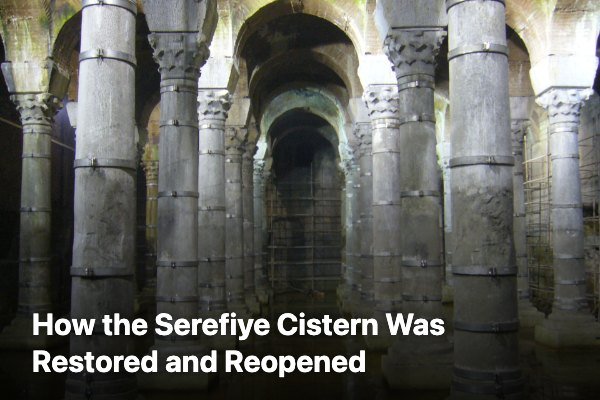
The Cistern of Theodosius, known locally as Şerefiye Sarnıcı, works as both a daytime stop and an evening show, and sits within walking distance of the Hagia Sophia.
Daytime visits run within a 9:00 am to 6:00 pm session window, according to the venue’s own ticket pages, and include access for the chosen session plus a mapping light show projected onto the cistern walls. The projection runs as a 360° mapping show, with two rotating programmes: “From Past to Present” and “Istanbul: City of Water Civilization.”
The evening option is different in character. Entrance for the dervish show is at 7:45 pm, the mapping show starts at 8:15 pm, and the whirling dervish performance with live Sufi music begins at 8:30 pm, finishing around 9:15 pm for a total runtime of about an hour and a half.
Snacks and drinks are included in that evening ticket.
Two practical notes matter here: luggage is not allowed inside, and professional photography needs written permission in advance, so this is not the place to bring a full camera rig unannounced. Anyone combining a cistern visit with the dervish show should book Theodosius Cistern tickets ahead of the evening session rather than turning up and hoping for space.
For background on how this particular reservoir supplied the ancient city, the piece on how the Cistern of Theodosius supplied ancient Istanbul covers the engineering story in more depth.
What is the Golden Horn cruise that locals take instead of the Bosphorus?
The Golden Horn sightseeing cruise runs a round trip along the estuary that separates the old city from Beyoğlu, passing roughly 20 landmarks that most Bosphorus cruises never reach.
The Golden Horn is a natural estuary, not a strait, which is why it carries calmer water and a different set of neighbourhoods along its banks. The cruise departs from either Karaköy Pier or Eminönü Pier three times a day, at 9:00 am, 12:30 pm and 4:00 pm, according to the operator’s own route pages reviewed in September 2026.
The full loop runs about two and a half hours, including a stop near Miniatürk of roughly 90 minutes before the boat turns back along the opposite shore.
On the outbound leg the boat passes Tersane Istanbul and the Rahmi Koç Museum; on the return it threads past Pierre Loti Hill, Eyüpsultan Mosque, Fener Patriarchate and the Balat neighbourhood, finishing back at Eminönü.
Tickets start from €9 per person as of September 2026, per the operator’s own product page, though park entry at Miniatürk and any drinks on board are sold separately and are not included in that fare.
Anyone checking ferry timetables or public boat routes around the Golden Horn and Bosphorus more broadly can cross-reference them against Istanbul’s city ferry operator before booking a private cruise, since public ferries cover some of the same shoreline at a different pace.
Where can you experience a traditional hamam ritual properly?
Çemberlitaş Hamamı and Cağaloğlu Hamamı in the old city are the two most historically significant bathhouses, but several smaller hamams nearby offer the same ritual at a lower price point.
A kese is a coarse woven mitt used during the exfoliation stage of a hamam visit, scrubbing away dead skin before a foam massage. The full sequence typically runs: a welcome and change into a peştemal wrap, warming on the heated marble platform known as the göbek taşı, the kese scrub, a foam massage, and a final cold-water rinse.
Prices and session lengths vary by venue, as this table shows, based on each operator’s own booking pages reviewed in September 2026.
| Hamam | Area | Price from | Typical session |
|---|---|---|---|
| Şifa Hamamı | Sultanahmet | €40 | 60 to 120 minutes |
| Gedikpaşa Hamamı | Old City | €50 | 60 to 90 minutes |
| Çemberlitaş Hamamı | Old City | €90 | varies by package |
| Hürrem Sultan Hamamı | Old City | €110 | 45 to 110 minutes |
Şifa Hamamı runs as a mixed-gender hammam with gender-matched therapists, which is unusual among the historic bathhouses and worth knowing before booking if that matters to you. The larger, more famous hamams keep strictly separate sections for men and women.
Is Çamlıca Tower worth the trip for the view alone?
Yes, for anyone who wants a skyline view of the Bosphorus and both continents without climbing a mosque minaret or queuing at a rooftop bar.
Çamlıca Tower stands at a reported height of 369 metres (unverified by independent measurement) and opens daily from 10:00 am to 10:00 pm, according to its own prices and visiting-hours page. Skip-the-line entry with complimentary Turkish tea starts from €25, as of the same September 2026 review, with higher tiers adding hotel transfer and meals.
Booking matters more here than at most attractions: tickets can be reserved up to two months ahead, same-day bookings close four hours before the slot, and visitors should arrive 15 minutes early with photo ID, since tickets are issued to a named individual and children may be asked for identification too.
July and August run as the busiest months, so earlier booking helps most during that stretch.
Walking Balat and Fener without a tour group
Balat and Fener are adjoining neighbourhoods on the Golden Horn’s southern shore, known for coloured houses, steep lanes, and churches that predate the Ottoman conquest.
Both neighbourhoods appear on the return leg of the Golden Horn cruise route, passing Fener Patriarchate, Sveti Stefan Church and the Virgin Mary Church, but walking them on foot afterward reveals details a boat cannot show: antique shops, small bakeries, and staircases between houses that only make sense at street level.
For visitors interested in the engineering that once carried water beneath streets like these, the overview on water engineering secrets of Istanbul’s cisterns connects what is visible above ground to what still survives underneath it.
Istanbul’s official museum authority, listed through Türkiye’s national museums portal, is also a reliable place to confirm current opening arrangements for any state-run site encountered along the way.
Frequently Asked Questions
Is the Cistern of Theodosius the same as the Basilica Cistern?
No, they are two separate Byzantine-era reservoirs in Istanbul’s old city, with the Cistern of Theodosius being the smaller and less visited of the pair.
How long does the Golden Horn cruise take?
About two and a half hours for the full round trip, including a stop of roughly 90 minutes near Miniatürk, according to the operator’s published schedule.
Do I need to book the dervish show in advance?
Yes, booking ahead is recommended given the fixed entrance and performance times each evening, and tickets can be arranged through the venue’s own booking page.
Can men and women visit a hamam together?
Usually not. Most historic hamams keep separate sections and gender-matched therapists, though a small number, such as Şifa Hamamı, run as mixed-gender venues.
What should I bring to the Cistern of Theodosius?
Nothing bulky. Luggage is not allowed inside, and professional camera equipment needs written permission arranged beforehand.
Is Çamlıca Tower open every day?
Yes, it operates daily from 10:00 am to 10:00 pm according to its own visiting hours page, though same-day bookings close four hours before the chosen slot.
Planning more than one of these stops in a single trip, in October or November 2026, works best when ticket times and ferry schedules are confirmed a day or two ahead rather than on arrival.
For a broader look at pairing a cistern visit with nearby sights and transport options, the walking guide to things to do near the Theodosius Cistern in Sultanahmet is a practical next stop, and travellers building a longer Istanbul itinerary around sites like these can also check current listings through istambul.com.
Planning a visit? Ask AI to summarise this page
Open this article in your preferred assistant to get the key facts for your trip.
Ask ChatGPTAsk ClaudeAsk Perplexity
Comment (0)