
Last reviewed and updated: October 2, 2026
There is a lift at the entrance and the walkway inside is level, which makes this one of the more accessible underground sites in Istanbul. What complicates it is that the venue does not publish any of that, the humidity keeps the floor damp, the railings are low, and there is nowhere to leave anything you cannot bring down with you.Here is what to do about each of those.Access at a glance
- Do call ahead on 0212 222 28 82 to confirm the lift is working on the day you plan to go.
- Do bring a compact fold pushchair rather than a large travel system, since there is nowhere to leave one.
- Do consider a baby carrier instead for infants, given the walkway width and the low light.
- Do use flat shoes with grip. Humidity runs near 100 percent and the stone is damp.
- Do time your arrival to ten minutes before the hour, since the projection show runs hourly and waiting is harder with mobility limits.
- Do not bring a suitcase or a large bag. They are refused at the door and there are no lockers.
- Do not lean on the internal railings. They are low and leaning is prohibited.
- Do not assume step free access is guaranteed. Nothing about the lift appears on the venue’s own website.
Is there a lift at the Theodosius Cistern?
Yes, and this is the single most useful thing on this page, because you will not find it on the official site.The Turkish Ministry of Education’s register of out of school learning environments lists the cistern with barrier free access, and visitors who have used it confirm a working modern lift at the entrance, usable by wheelchair users, people who struggle with stairs and families arriving with pushchairs.The venue’s own website says nothing about this either way. Its published visitor rules cover smoking, pets and luggage, and stop there.The practical consequence is that you should treat step free access as available but unconfirmed by the operator. If it is essential to your visit, phone 0212 222 28 82 and ask whether the lift is in service that day, rather than travelling on the assumption.The staircase, if you use it
The alternative access is a staircase from the modern glass entrance pavilion at street level down into the chamber.The venue does not publish a step count, so anyone who quotes you one is guessing. What is published is the advice, which comes from the operator’s own visitor guidance and from the education ministry’s page.Hold the handrail. The steps are stone and the humidity keeps everything faintly damp.Do not wear heels. The stairs and walking paths are explicitly described as unsuitable for them.Do not run. Stated by both sources, and aimed at children.Inside the chamber
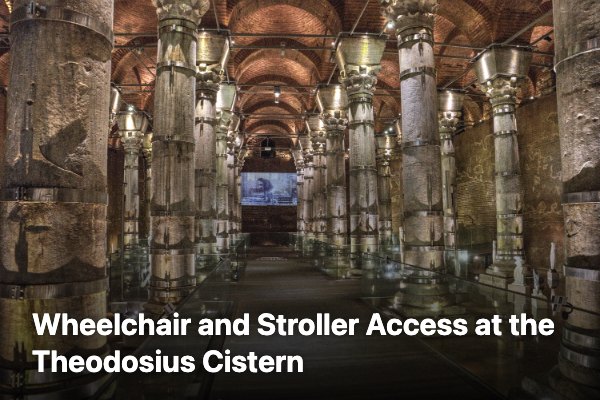
Once you are down, the route is a flat platform walkway without obstacles. The chamber is a single hall of 24 by 40 metres, so there is no circuit to complete and no upper level to reach.Four conditions to plan for.Humidity near 100 percent. This is the operator’s own figure, and it is why the projection equipment sits in purpose built cabinets. Water drips from the ceiling in places, so keep electronics and anything on a wheelchair tray covered.A damp floor. Both the venue’s guidance and the education ministry’s page advise care underfoot. For a wheelchair this is a traction issue on the turns rather than a slip risk.Low railings. Leaning on them is prohibited. Worth knowing if you use a railing for balance, because these are not built for it.Dim lighting throughout, and dimmer still during the show. The lights do not come fully up afterwards, so the whole visit is low light. If you have limited vision, this is the constraint that matters most and nothing about it can be adjusted.The temperature is noticeably cooler than street level, since the chamber is underground behind two and a half metre walls. Bring a layer in any season.Pushchairs, specifically
The lift solves getting down. Two other things do not.There are no lockers. The official visitor rules state this outright, and add that large items such as suitcases are not allowed inside for security and capacity reasons. So if the lift is out of service, there is no option to leave a pushchair and carry the child down.The walkway is narrow in places and dimly lit, which makes a large travel system awkward even when it fits.A compact fold pushchair or a baby carrier is the practical answer. For infants, the carrier is easier throughout and removes the question entirely.Note that this is a stricter position than at Hagia Sophia, where pushchairs must be folded and carried on the visitor route. Here, the lift means you can usually keep it, provided it is not large.Facilities, and what to sort out beforehand
| Facility | Position |
|---|---|
| Lift | Present, not published by the venue, confirm by phone |
| Lockers | None, stated officially |
| Large luggage | Refused at the door |
| Toilets | Sources conflict, treat as unavailable and go beforehand |
| Baby changing | No information published either way |
| Seating inside the chamber | None during normal opening hours |
| Cafe | At the exit level |
| Accessible parking | Not published |
The squares outside
Immediately at the entrance there is an archaeological park with two public squares, created when the municipal buildings above the cistern were demolished in 2010, separated by a reflecting pool with mature trees along the south and west sides.It is free, open, level and shaded, and it is the natural place to wait, regroup or rest before or after. For anyone travelling with a wheelchair user or a small child, this is the practical staging area, and it is one of the reasons this site works better than several others in the district.Getting there
The entrance is on Piyer Loti Caddesi in Binbirdirek, just off Divan Yolu.By tram. The T1 line stops at Cemberlitas and Sultanahmet, both five to ten minutes on foot. Istanbul’s trams have level boarding at the platforms, which makes this the easiest approach.On foot from Sultanahmet Square. About five minutes, along paved and largely level ground.The approach itself. Divan Yolu is a wide flat street. The turn into Piyer Loti Caddesi is short and the entrance pavilion is visible from it. This is a genuinely easy approach by the standards of the historic peninsula, where most sites involve cobbles and gradients.Timing the visit around the show
The 360 degree projection mapping show runs on the hour and lasts nine minutes and forty seconds. This matters more for a visitor with mobility limits than for anyone else, because arriving mid cycle can mean up to forty minutes waiting at the door with nowhere inside to sit.Arrive at ten minutes to the hour. You go down, the show begins shortly after, and the whole visit runs 30 to 45 minutes.| Time of day | Why it suits |
|---|---|
| At opening | Emptiest chamber, easiest for a wheelchair or pushchair to move freely |
| Late morning | Busiest, hardest to navigate, avoid |
| Early afternoon | Steady, no queue at the ticket desk |
| Late afternoon | Quiet again |
Tickets and payment
| Category | Price |
|---|---|
| Foreign visitor | 900 TL |
| Full, Turkish residents | 330 TL |
| Reduced, students, teachers, police, military | 90 TL |
| Children 6 and under with family | Free |
How it compares with the alternatives nearby
Worth stating plainly, because access varies enormously across the historic peninsula.The larger cistern nine minutes away is roughly ten times the area with 336 columns, and involves considerably more walking once inside, along with a queue that frequently forms at the entrance.Hagia Sophia routes foreign visitors up a ramp to the upper gallery, and its own visitor rules state that the ramps and stairs are not suitable for visitors with walking difficulties, who are directed to a different entrance.Against those, a single level hall reached by a lift, with a 45 minute visit and no queue, is the easier proposition. The two cisterns are compared in more detail in the comparison guide.What to ask when you phone ahead
Four questions, in this order.Is the lift working today? The one that decides everything.What time do you close today? Because the published hours contradict each other.Is there a free or reduced rate for a disability card holder and a companion? The operator’s general policy suggests yes, but confirm for this site.Can we bring a folded pushchair down? Since there is nowhere to leave one.Frequently asked questions
Is the Theodosius Cistern wheelchair accessible?
There is a lift at the entrance and the internal walkway is level, so in practice yes. The venue does not publish this, so confirm the lift is in service by phoning 0212 222 28 82 before travelling. The floor is damp and the railings are low.Can you take a pushchair into the Theodosius Cistern?
Usually, using the lift, provided it is a compact fold. Large travel systems are awkward on a narrow dimly lit walkway, and there are no lockers, so there is nowhere to leave one if the lift is unavailable. A baby carrier is the simpler option for infants.How many steps are there down to the cistern?
No source publishes a step count, so any figure you see is a guess. The staircase runs from the modern glass entrance pavilion at street level down into the chamber, and the operator advises holding the handrail and avoiding heels.Are there lockers at the Theodosius Cistern?
No. The official visitor rules state that lockers are not available and that large items such as suitcases are not permitted inside, for security and capacity reasons.Is there a toilet at the Theodosius Cistern?
Sources disagree. The entrance building was designed with toilets on the upper floor, but visitors report none available from inside the chamber. Treat facilities as unavailable and use them before you arrive.Is the cistern free for disabled visitors?
The operator grants free entry across its museums to holders of a disability identity card and their companions, with identification shown at the desk. This is stated as a general policy rather than specifically for this site, so confirm at the ticket desk.Is there anywhere to sit inside?
Not during normal opening hours. Temporary seating is installed for concerts and evening events, but a daytime visit is a walkway with no benches. The public squares immediately outside the entrance are the place to rest.How dark is it inside?
Dim throughout, and dimmer during the projection show, with the lights not coming fully up afterwards. This is the condition least amenable to adjustment, so if low light is a problem for you, it is worth weighing before booking.Is the Theodosius Cistern wheelchair accessible?
Access to the underground space is primarily via stairs, which makes independent wheelchair access difficult; please contact us in advance to discuss the options.
Questions answered in this guide
- Is there a lift at the Theodosius Cistern?
- Is the Theodosius Cistern wheelchair accessible?
- Can you take a pushchair into the Theodosius Cistern?
- How many steps are there down to the cistern?
- Are there lockers at the Theodosius Cistern?
- Is there a toilet at the Theodosius Cistern?
- Is the cistern free for disabled visitors?
- Is there anywhere to sit inside?
- How dark is it inside?
- Is the Theodosius Cistern wheelchair accessible?
- Can I bring a stroller?
- Are there lifts at the Theodosius Cistern?
- How many steps are there?
- Who can I contact about accessibility?
Can I bring a stroller?
Because access is via stairs, a stroller can be hard to manage, so a baby carrier is often more practical.
Are there lifts at the Theodosius Cistern?
Please contact us before your visit to ask about current accessibility arrangements and any assistance available.
How many steps are there?
Visitors descend a flight of stairs to reach the cistern floor, so please plan accordingly if you have limited mobility.
Who can I contact about accessibility?
You can reach us by email at info@cisternoftheodosius.com to discuss accessibility before booking.
Planning your trip to Istanbul? Read our Theodosius Cistern visit guide for directions and practical tips, or book your tickets for a daytime visit or the evening whirling dervish ceremony.
Planning a visit? Ask AI to summarise this page
Open this article in your preferred assistant to get the key facts for your trip.
Ask ChatGPTAsk ClaudeAsk Perplexity
Comment (0)