
Last reviewed and updated: October 31, 2026
The best way to plan things to do in Istanbul is to clear the Old City first, because its sites sit within walking distance of each other and get crowded fast after mid-morning. Once Sultanahmet and its underground cisterns are done, the rest of the city opens up by tram, ferry and foot.
Questions answered in this guide
- Why Start in the Old City?
- What Should a First Day in Sultanahmet Look Like?
- Where Does the Cistern of Theodosius (Serefiye Sarnıcı) Fit In?
- Are There Other Cisterns Worth Seeing Nearby?
- What’s Worth Doing Right Around Sultanahmet Before Moving On?
- What Comes After the Old City?
- Is a Hamam Visit Worth Fitting In?
- Is Çamlıca Tower Worth the Trip Across the City?
- How Should a Three-Day Istanbul Itinerary Be Structured?
- What Should Be Booked Before Arrival?
- How many days are enough for the Old City alone?
- Is the Cistern of Theodosius the same as the Basilica Cistern?
- Can luggage be brought into the cistern?
- What is the best way to move between the Old City and the Bosphorus?
- Is the evening dervish performance different from the daytime cistern visit?
- Does a hamam visit need to be booked in advance?
- Best for: first-time visitors with two to four days and no car
- Old City anchor: Sultanahmet, home to the Cistern of Theodosius and its neighbors
- Getting around: tram for the Old City, ferry for the Bosphorus and Golden Horn
- Time of year: as of October 2026, crowds thin out compared to the July-August peak
Why Start in the Old City?
Because almost every major historic site in Istanbul sits inside a walkable triangle between the Hippodrome, the Hagia Sophia and the Grand Bazaar.
Sultanahmet is the district where Byzantine and Ottoman Istanbul physically overlap. Mosques, palaces and underground water systems sit a few minutes apart on foot, so a visitor who starts here saves the transit time needed later for the Bosphorus shoreline or the Asian side.
It also means the heavier, more tiring sites (long queues, stone floors, stairs) get done early, while legs and patience are fresh. Save the boat trips and hillside viewpoints for the afternoons and the days that follow.
What Should a First Day in Sultanahmet Look Like?
A first day works best moving from ground level down into the cisterns, then back up to the mosques and palace grounds.
A cistern is an underground reservoir built to store water for a city that had no reliable surface source nearby. Byzantine engineers built several beneath what is now Sultanahmet, and a few remain open to visitors today. For context on how these structures fit into the ancient city’s water supply, see how the Cistern of Theodosius supplied ancient Istanbul.
After the cisterns, the Hippodrome, the Blue Mosque and Hagia Sophia are all within a short walk, which is why most visitors treat this stretch as a single half-day loop rather than separate outings.
A short list of what belongs on day one:
- One or two cisterns, visited before the midday heat or crowds build
- Hagia Sophia and the Blue Mosque, both free-standing and close together
- Topkapi Palace grounds, which take longer than most visitors expect
- A slow walk through the Grand Bazaar’s older lanes rather than the main tourist aisle
Where Does the Cistern of Theodosius (Serefiye Sarnıcı) Fit In?
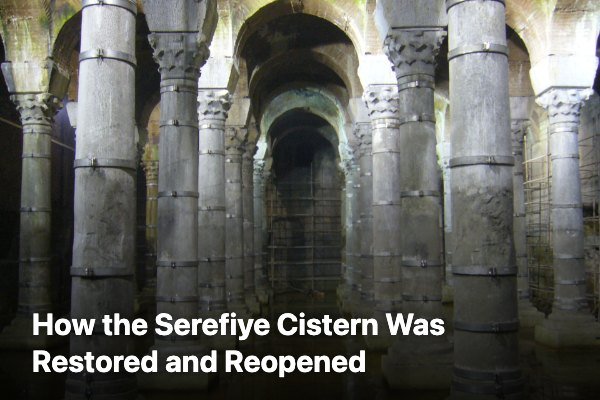
The Cistern of Theodosius, also called Şerefiye Sarnıcı, is a smaller, restored Byzantine cistern close to the main Sultanahmet cluster, and it works well as the first underground stop of the day.
The venue runs a daytime session from 09:00 to 18:00, which includes a mapping light show projected onto the vaulted brick ceiling.
There is also an evening ticket built around a performance: entry at 19:45, the mapping show at 20:15, a whirling dervish performance with live Sufi music at 20:30, and a close around 21:15, with snacks and drinks included.
A few practical notes matter before arrival. Luggage is not allowed inside, so day-trippers with bags should plan storage elsewhere first. Professional photography needs written permission arranged in advance, which rules out spontaneous shoots with full camera gear.
Visitors who want to understand the engineering behind the space, rather than just see it, can read water engineering secrets of Istanbul cisterns, which covers how these Byzantine reservoirs channeled and stored water across the city. Book Theodosius Cistern tickets ahead of a Sultanahmet day, since the evening performance slot is limited and sells out on busy weeks.
Are There Other Cisterns Worth Seeing Nearby?
Yes. Istanbul has several lesser-known cisterns beyond the famous Basilica Cistern, and two in particular reward a short detour.
The Cistern of Aspar sits further from the main tourist path and gives a sense of scale without the queues of the central sites; details are in Cistern of Aspar, a Byzantine gem in Istanbul.
The Cistern of Aetius is another open-air Byzantine reservoir, now partly used as a public space, covered in discover the ancient Cistern of Aetius in Istanbul.
Anyone drawn to the underground architecture rather than the mosques and palaces above ground should treat these as a separate half-day, since they sit apart from the main Sultanahmet loop and are easy to rush through if squeezed in at the end of a long day.
What’s Worth Doing Right Around Sultanahmet Before Moving On?
Several smaller sites and food stops sit within a few minutes of the cistern cluster and work well as a buffer before heading to the Bosphorus.
A detailed walking list, organized by distance from the cistern entrance, is laid out in things to do near Theodosius Cistern in Sultanahmet. It covers tea houses, smaller mosques and the quieter back streets that most itineraries skip.
Readers curious about what lies beneath the visible monuments, including symbols carved into cistern columns and artifacts found during restoration work, can also look at hidden symbols found in Istanbul cisterns and rare artifacts discovered in Istanbul cisterns.
What Comes After the Old City?
After Sultanahmet, the Bosphorus and the Golden Horn are the next natural stops, both reached easily by tram and ferry from the Old City.
A Bosphorus sightseeing cruise runs about two hours and starts from €12 per person as of September 2026, according to the operator’s own product pages, with departures at 12:30 pm and 4:00 pm and an on-board audio guide included.
A sunset version includes a welcome drink and snacks and starts from €50 per person for a similar two-hour run, departing at 7:00 pm in summer season.
The Golden Horn is a narrow natural estuary that separates the historic peninsula from the newer districts to the north, and a round-trip sightseeing cruise along it covers around 20 landmarks in roughly two and a half hours, starting from €9 per person as of September 2026.
Boats stop at Miniatürk for about 90 minutes before the return leg past Balat and Fener.
Visitors short on time, including cruise passengers docked for a single day, can see how to sequence the Old City and a short boat trip in a fast Istanbul tour for cruise passengers.
Is a Hamam Visit Worth Fitting In?
Yes, and it pairs well with a day of walking stone floors and climbing cistern stairs.
A hamam is a traditional Turkish steam bath, and the ritual typically runs through warming on a heated marble platform, a scrub with a kese (a coarse exfoliating mitt), a foam massage and a final cold rinse.
Historic options in the Old City, such as Çemberlitaş Hamamı and Cağaloğlu Hamamı, start from €90 per person as of September 2026, according to the platform’s own venue listings, while simpler neighborhood hamams in areas like Sultanahmet start lower, from €40.
Booking ahead matters at the well-known historic hamams, since walk-in slots fill during the busier afternoon hours.
Is Çamlıca Tower Worth the Trip Across the City?
For visitors who want a wide view over the Bosphorus and both shores, yes, though it sits on the Asian side and takes planning.
The tower is open daily from 10:00 am to 10:00 pm, and skip-the-line entry with a complimentary Turkish tea starts from €25. Arrive about 15 minutes early and bring identification, since tickets are issued to a named visitor and ID may be checked even for children.
Same-day bookings close a set number of hours before the visit, so this is not a spontaneous add-on to an Old City day.
For most two or three day itineraries, Çamlıca Tower fits better on a day that also covers the Asian side’s markets and waterfront rather than being squeezed in after Sultanahmet.
How Should a Three-Day Istanbul Itinerary Be Structured?
A workable structure spreads the Old City, the water and the newer districts across three separate days rather than mixing them.
| Day | Focus | Main activities |
|---|---|---|
| Day 1 | Old City | Cisterns, Hagia Sophia, Blue Mosque, Grand Bazaar |
| Day 2 | Water | Bosphorus or Golden Horn cruise, hamam in the afternoon |
| Day 3 | Beyond Sultanahmet | Asian side, Çamlıca Tower, local neighborhoods |
This sequence avoids backtracking across the city and keeps the most physically demanding sites (palace grounds, cistern stairs) early, when energy is highest.
What Should Be Booked Before Arrival?
The evening cistern performance, the historic hamams and any cruise with a fixed departure time should all be booked ahead rather than left to chance.
Timed-entry sites and performances with limited capacity, like the Cistern of Theodosius evening show, sell out on weeks when cruise ships are in port or during school holidays. Transport details, including current ferry routes and the official metro map, are maintained by Istanbul’s municipal ferry operator and Istanbul’s metro authority, both useful for checking live schedules before a trip.
Frequently Asked Questions
How many days are enough for the Old City alone?
One full day covers the main sites comfortably, though a second half-day helps if cisterns and smaller museums are a priority.
Is the Cistern of Theodosius the same as the Basilica Cistern?
No, they are separate Byzantine cisterns in Sultanahmet; the Cistern of Theodosius is smaller and includes its own mapping light show and evening performance.
Can luggage be brought into the cistern?
No, luggage is not permitted inside, so visitors arriving with bags should arrange storage before the visit.
What is the best way to move between the Old City and the Bosphorus?
Tram to the waterfront piers, then ferry; both connect directly and avoid the need for a taxi across the peninsula.
Is the evening dervish performance different from the daytime cistern visit?
Yes, the evening ticket adds a whirling dervish performance with live Sufi music, plus snacks and drinks, on top of the mapping show included in the daytime session.
Does a hamam visit need to be booked in advance?
Yes for the well-known historic hamams, since afternoon slots are the first to fill and walk-ins are not guaranteed a place.
Anyone sequencing the Old City with a cistern visit, a Bosphorus cruise and a hamam afternoon can check current availability and build the rest of the trip around it at istambul.com.
Planning a visit? Ask AI to summarise this page
Open this article in your preferred assistant to get the key facts for your trip.
Ask ChatGPTAsk ClaudeAsk Perplexity
Comment (0)